How many heritage institutions release their digital collections on open access terms? Since 2018, Dr Andrea Wallace have led the Open GLAM Survey to find out the answer.
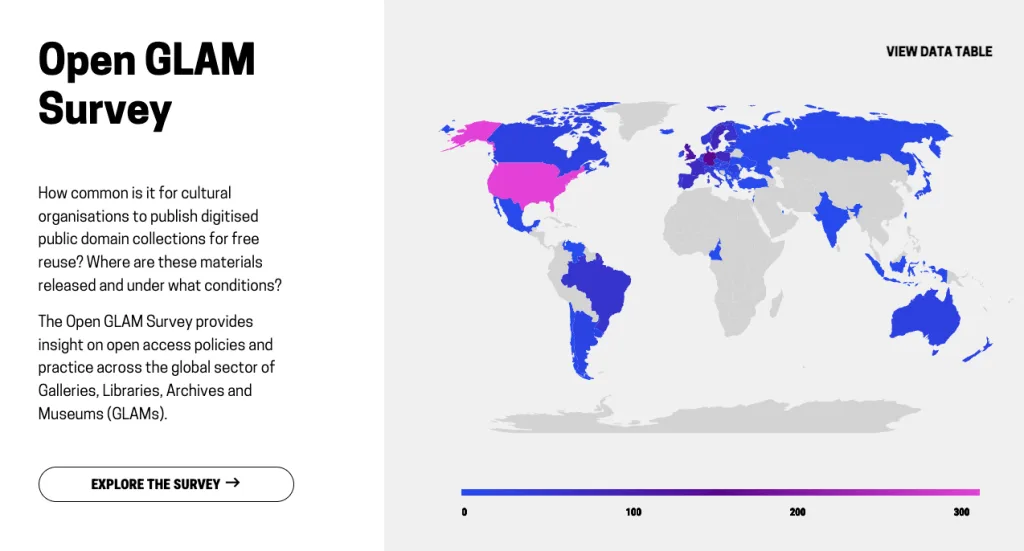
The Open GLAM Survey examines how GLAMs (Galleries, Libraries, Archives and Museums) make open access data – whether digital objects, metadata or text – available for re-use. Its working definition of ‘open’ is guided by Open Knowledge Foundation’s Open Definition. Its summary statement is ‘open means anyone can freely access, use, modify, and share for any purpose’ and the Definition helpfully provides a list of licences, rights statements and legal tools that accord with this spirit.
The Survey covers data that GLAMs make available on their websites and/or external platforms. It focuses on digital surrogates of objects in the public domain, where any term of copyright for the material object has expired or never existed in the first place. Survey data is gathered via desk research and outreach to the global GLAM community. The Survey has an extensive range of data points including institution name, type and country; licences/rights statements for digital surrogates and metadata; links to Terms of Use and copyright policies.
The first version of the Open GLAM Survey contained around 40 organisations and was housed in a publicly available Google Sheet, uploaded regularly to the Internet Archive. By 2024, that list had grown to nearly 1,700 organisations from 55 countries.
The new version of the Open GLAM Survey was launched in December 2024, in collaboration with the GLAM-E Lab and the design team at Objectively. It improves the readability of the data and its structure, automating new data pulls and data updates from GLAM websites and publication platforms, producing an interactive, searchable version of the data with new visualisations.
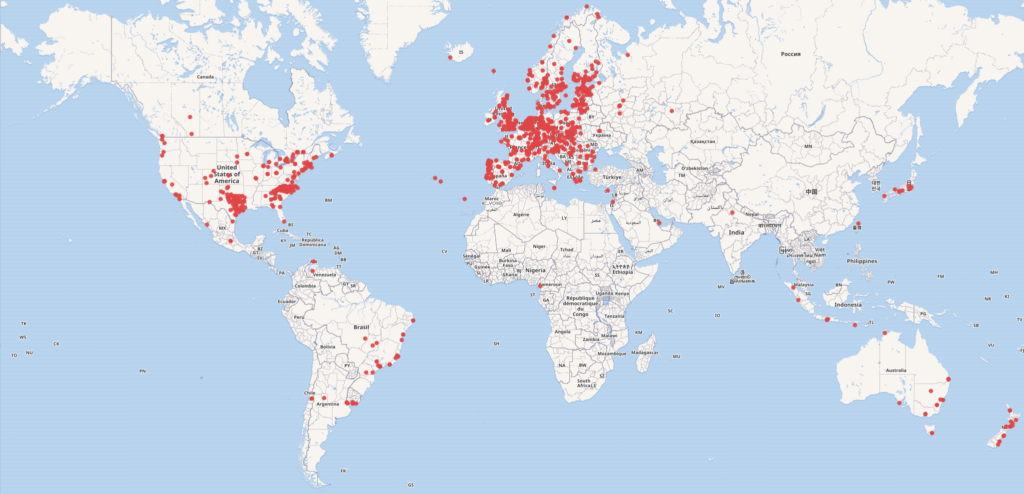
The Survey provides direct links to the open data, totalling more than 95 million digital objects from over 1700 institutions around the world. It is annotated extensively in Wikidata (Q73357989), which facilitates SPARQL queries and data visualisations.
To learn about the history of the Open GLAM Survey, please read my series of introductory articles: