Micro-museum platform MagnificentH interviewed me for its In Conversation With series. The interview text is reproduced below; visit the MagnificentH website for the original.
In Conversation with: Doug McCarthy
We talk to the cultural heritage specialist about preserving digital museum collections, common copyright misconceptions and what being a “gatekeeper” really means.
Doug McCarthy is an open access scholar and cultural heritage specialist who has spent years researching how museums can become more impactful and accessible online.
He is particularly passionate about copyright and licensing, and advises institutions on why they should share their archives in the public domain.
We sat down with him to discuss his work in detail and uncover his story.
To begin, how would you describe the work you do for someone who may not be familiar with the world of museums and copyright?
Imagine finding a striking image of a centuries-old painting on a museum website. Can you freely download it for a book, a school project, or a presentation—or is access blocked by a restrictive licence or a fee? The short answer is that it depends, because copyright and contract law heavily dictate how cultural heritage is accessed and reused online. In my research and writing, I explore and expose the complex set of laws, permissions, and licences that determine how institutions share their collections digitally.
What first drew you into these questions of access, the public domain, and cultural reuse?
In 2005, I became the Picture Library Manager at Royal Museums Greenwich. We managed vast historical collections that were physically in the public domain, yet our daily workflow was heavily transactional. We asserted copyright in images, evaluated commercial usage, charged fees, and essentially acted as gatekeepers. It gradually became clear that such a guarded approach did not align with the transformative opportunities presented by the digital age.
What do you think people most often misunderstand about copyright in relation to cultural heritage?
Museum professionals often assume that digitising an old object automatically creates a new copyright. The logic is that because an institution invests time, money, and expertise in high-quality photography of a centuries-old work, they deserve new copyright in the resulting digital file. This position is rarely supported by copyright law.
In the UK, for example, many institutions still rely on the outdated idea that “skill and labour” alone generate copyright. However, recent case law—specifically the Court of Appeal’s ruling in THJ v Sheridan—has affirmed that a work must bear an author’s “personal touch” through creative choices. A technical facsimile simply cannot meet this standard. The Court of Appeal’s ruling was entirely in line with EU law.
Users will find the same public domain artwork labelled “in copyright” by one museum and “public domain” by another. This inconsistency creates what I call “Schrödinger’s copyright“. Furthermore, some institutions apply restrictive Creative Commons licences to these images—a misuse of the framework, as you cannot licence rights you do not own. By relying on outdated legal concepts and using contract law to artificially restrict access, many museums maintain a closed status quo. To an outsider, this can look like rent-seeking gatekeeping.
When museums digitise collections that are part of our shared cultural memory, what should they owe the public?
At its core, digitisation should be about democratising access. If an artwork or historical artefact is in the public domain physically, the starting premise should be that it remains in the public domain digitally.
However, “open by default” is not a universal solution. For indigenous archives, sacred objects, or culturally sensitive materials, Western legal frameworks often fall short or cause active harm. In those specific contexts, what institutions owe source communities is respect and consultation to establish appropriate access conditions.
“At its core, digitisation should be about democratising access.”
But for the vast majority of standard historical collections, friction-free access is what museums owe the public. When an institution claims a new copyright on a faithful reproduction, they create a new digital enclosure. The public usually funds the care of these collections; they shouldn’t face an artificial toll to reuse a digital surrogate.
Do you think institutions sometimes become too cautious in the name of protection, even when openness would create greater public value?
Undoubtedly. But we must distinguish ethical caution from administrative risk aversion. Being cautious and protective of Indigenous cultural heritage or Traditional Knowledge is absolutely necessary.
However, that is rarely the kind of caution holding the sector back. Most institutional risk aversion stems from a fear of losing narrative control or a reluctance to let go of image licensing revenue. My research into UK museums shows that the commercial windfall from image licensing is rarely what it is cracked up to be. Meanwhile, the cost of locking down everyday public domain collections is massive. It stifles research, limits education, and prevents a vibrant, participatory cultural ecosystem.
What should cultural publishers understand better about using images in context rather than as standalone reproductions?
We need to shift away from treating digital images as mere illustrations and start seeing them as primary sources in a wider, dynamic narrative. When an image is published online, it can become part of a broader, interconnected conversation. Using a public domain artwork should enable commentary, remixing, and community interpretation. Publishers should embrace the idea that once an image is released into a digital space, its value grows not by how tightly it is guarded, but by how widely it is contextualised and shared.
“When an image is published online, it can become part of a broader, interconnected conversation.”
In a way, do you think the idea of the museum has become somewhat detached from its origins — the personal “cabinet of wonders” — where the appeal once lay in the intimate act of one person sharing their own treasure trove on a small scale?
That is a brilliant way to frame it. The traditional, large-scale institutional museum is vital, but its sheer scale can sometimes sanitise the experience. The original Wunderkammer was intensely personal, idiosyncratic, and deeply connected to the person sharing it. When cultural stories are shared on a smaller, more personal scale, they often resonate much more deeply. The shift towards digital storytelling and platform-based publishing allows us to reclaim some of that intimacy, enabling individuals and communities to curate their own “cabinets” to tell stories that are highly specific, local, and emotionally resonant.
If you could change one thing about how museums think about reuse, what would it be?
I would encourage them to default to trust rather than control. Instead of worrying about how people might “misuse” an image, institutions should recognise open access as a powerful marketing multiplier. After all, intellectual property rights have never been an effective deterrent for bad actors.
By removing barriers and encouraging reuse, collections travel further and spark conversations with audiences that traditional marketing could never reach. Since most people globally will never visit collections in person, open access online offers greater reach and a deeper public connection. The value of this visibility far outweighs the minor revenue generated by locking images away.
“When cultural stories are shared on a smaller, more personal scale, they often resonate much more deeply.”
Finally, what was the inspiration for the micro-museum you created?
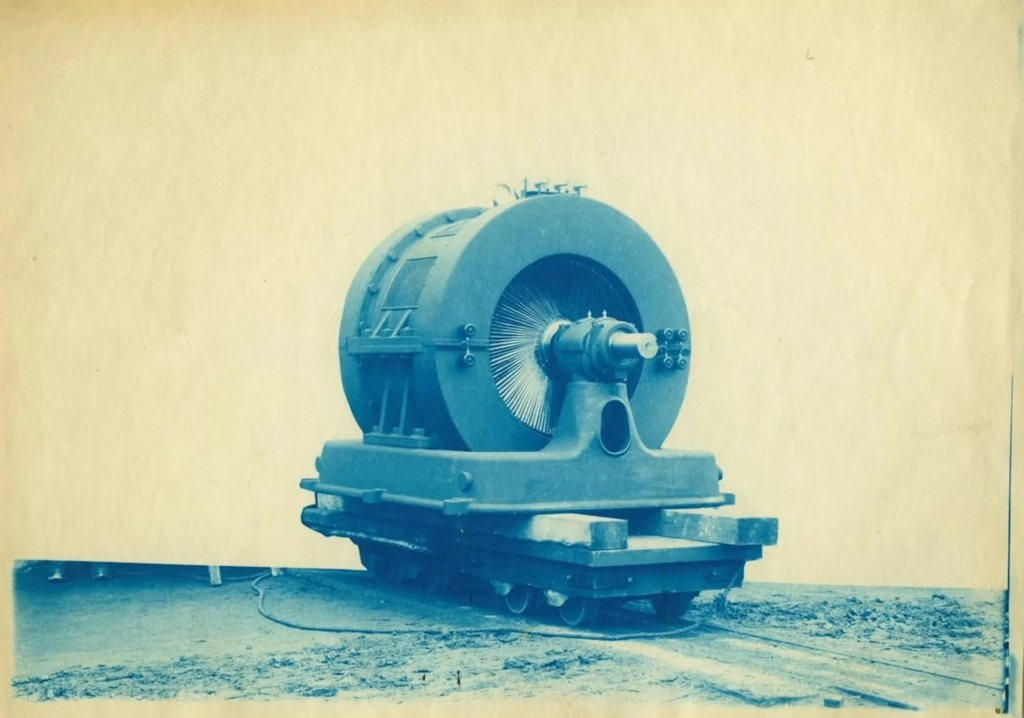
I’m drawn to the graphic simplicity of cyanotypes, a medium dating back to the 1840s. There’s something remarkably modern about their bold Prussian blue backgrounds and clean silhouettes. They prove that a minimal palette can often be more compelling than a richly coloured composition. Best of all, you can create your own with just sunlight and a few simple materials—I highly recommend trying it!
Discover Doug’s micro-museum and follow him on MagnificentH here.
Featured image for “In conversation with: Doug McCarthy” is from his micro-museum Cyanotypes, Tekniska museet, Sweden, CC pdm, via DigitaltMuseum.